

Tech News Roundup: What Mattered This Week
Even over the Thanksgiving stretch, the tech industry did anything but slow down. From social media scale and AI-generated worlds to licensed AI music, experimental hardware, and next-gen XR headsets, the past few days delivered a dense stream of announcements that point to where consumer tech, AI, and entertainment are heading next.

Quick Takeaways
- Snapchat is closing in on 1 billion monthly active users, driven largely by growth in India and Pakistan, even as engagement softens in the U.S. and Europe.
- Meta’s WorldGen can turn text prompts into fully explorable 3D environments up to 50×50 meters, exportable into Unity and Unreal.
- Warner Music Group + Suno struck a licensing deal that will enable opt-in artist likenesses in AI music, with a tiered download model rolling out in 2026.
- Sam Altman and Jony Ive say OpenAI’s first consumer device has reached functional prototype status and is targeting launch within two years.
- Apple Vision Pro is getting new immersive sports and lifestyle content built around Real Madrid and Red Bull’s extreme sports catalog.
- Meta Hyperscape now supports up to eight people in the same scanned environment, with on-device rendering and mobile access.
- Casio’s Moflin AI pet is now widely available outside Japan at around $429, using “emotional AI” for companion-style interactions.
- Pico is preparing a 2026 mixed-reality headset with 4K micro-OLED displays and a custom passthrough chip, positioned as a Vision Pro rival.
- Hotel Infinity, from the creators of Manifold Garden, continues development as a VR puzzler set in an “impossible” self-folding hotel.
- Google Flow is emerging as a flagship AI filmmaking workflow, combining Veo-powered video generation with creative-tool integrations.
Snapchat Nears 1 Billion Users — But Profits Lag
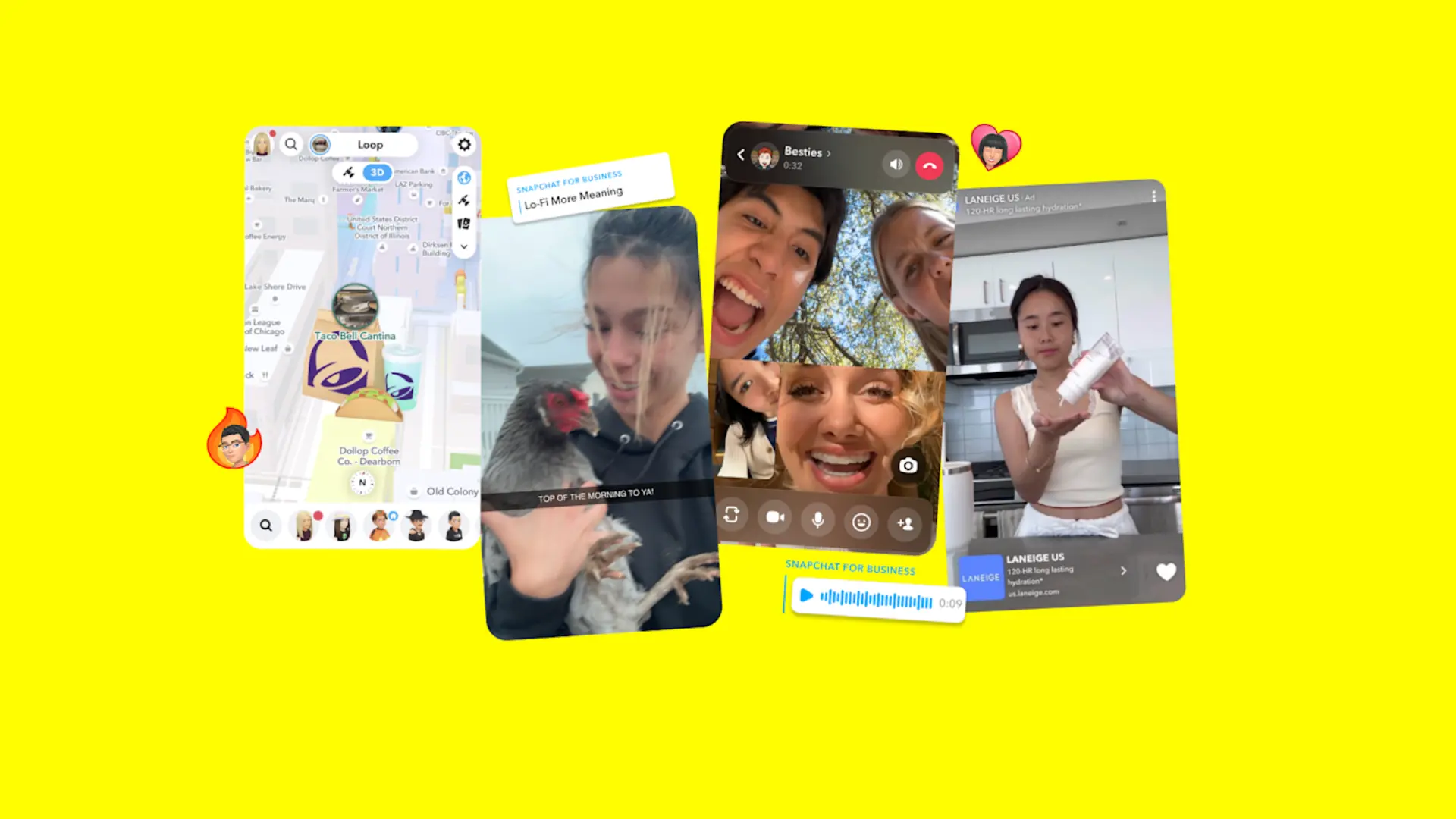
Snap confirmed that Snapchat now serves roughly 943 million monthly active users worldwide, putting it within striking distance of the symbolic 1-billion-user club. The company’s growth story, however, is heavily regional. In India—where TikTok remains banned—and in Pakistan, Snapchat usage has surged, helped by the rapid spread of inexpensive Android phones.
The flip side: in the United States and major European markets such as France, Germany, Italy, and the U.K., monthly active users have declined, according to third-party analytics. That mismatch creates a monetization puzzle: Snap’s user base is expanding, but average revenue per user is higher in the very regions where engagement is softening. CEO Evan Spiegel reportedly told employees the company is in a “crucible moment” and is doubling down on AR-driven advertising formats and a planned 2026 smart-glasses launch as its next growth chapter.
Meta WorldGen: From Text Prompts to Walkable 3D Worlds
Meta’s Reality Labs introduced WorldGen, a research system that can generate fully explorable 3D environments from natural-language prompts like “medieval village at dusk” or “Mars base station.” Instead of a single camera orbit or stitched panorama, WorldGen builds an environment up to 50×50 meters with consistent styling, physics-aware layout, and a navigation mesh so that characters—or players—can actually walk through the space.
The pipeline combines high-level layout generation with diffusion-based reconstruction, mesh refinement, and texturing. Teams can then export scenes directly into engines such as Unity and Unreal for further editing. Current limitations include a focus on single-level spaces, imperfect support for seamless indoor–outdoor transitions, and limited texture reuse, which constrains performance on mobile VR hardware. Meta stresses that WorldGen is a research project, not yet a shipping feature in Horizon Worlds, but it clearly signals where generative XR tools are heading.

Warner Music & Suno: A Licensed AI Music Truce
After initially filing copyright lawsuits against AI music platforms, Warner Music Group (WMG) has now reached a settlement and licensing agreement with Suno, one of the leading text-to-music generators. Under the deal, Suno will retire its unlicensed models and introduce licensed AI models in 2026, trained on music cleared by rights holders.
The partnership allows users to create AI-generated tracks in the voices and styles of artists who explicitly opt in; those artists retain control over how their names, likenesses, and compositions are used. Free-tier users will be able to stream and share their creations but not download files. Paying subscribers will get a monthly download allowance with the option to buy additional capacity—a structure meant to reflect the value of the underlying IP while still encouraging experimentation.

Altman & Ive Show OpenAI Hardware Prototype
At Emerson Collective’s 2025 Demo Day, OpenAI CEO Sam Altman and designer Jony Ive confirmed that their first AI-centric hardware device has reached the working-prototype stage. Public details are intentionally sparse, but multiple reports describe the product as roughly phone-sized, screen-free, and designed to feel calmer and more “peaceful” than a modern smartphone.
Ive hinted that the team is aiming to ship in under two years and spoke about a playful internal benchmark: the device should be appealing enough that people almost “want to bite it,” shorthand for an object that feels instinctively approachable rather than intimidating. Altman, for his part, emphasized simplicity, ambient intelligence, and a focus on reducing screen time rather than adding another brightly lit rectangle to people’s lives.

Vision Pro Adds Real Madrid and Red Bull Immersive Content
Apple continues to address the “content problem” for Apple Vision Pro by expanding its Apple Immersive Video slate. Recent announcements highlighted two high-profile partnerships:
- An immersive documentary experience built around Real Madrid, tying into Apple’s broader sports strategy.
- A “World of Red Bull” series that brings backcountry skiing and other extreme sports into a 180-degree, 3D, high-frame-rate format optimized for Vision Pro’s 4K-per-eye pipeline.
All of this content is distributed through the Apple TV app and uses the Apple Immersive Video format—180° stereoscopic video with high dynamic range and spatial audio—to put viewers in the middle of the action. For now, Apple has not announced support for non-Apple headsets, underscoring Vision Pro’s positioning as a premium, tightly integrated ecosystem product.

Meta Hyperscape: Turning Real Places into Shared VR Rooms
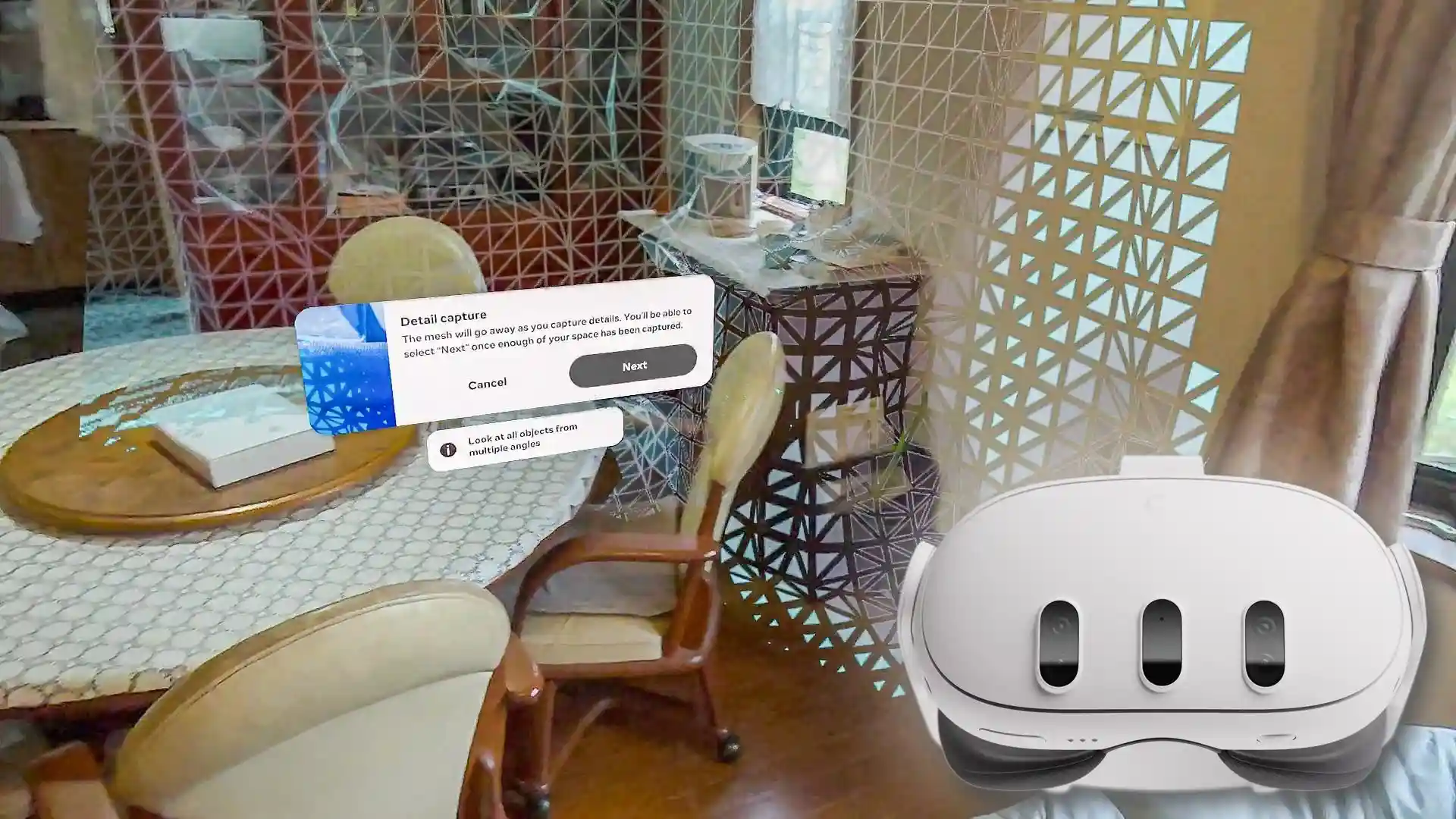
Meta Hyperscape started as a “teleportation” tool that let Quest users scan their living rooms or favorite hangouts into highly detailed VR replicas. Now Meta is rolling out a social layer: up to eight people can join the same Hyperscape world simultaneously, either in VR via Quest 3/3S or on mobile via the Meta Horizon app.
A key technical shift is that rendering has moved from cloud servers to on-device processing, which reduces latency and makes sessions feel more responsive. Meta is pitching this not just as another metaverse toy, but as a way for families and friends who cannot meet physically to share familiar spaces together—from a grandparent’s kitchen to a scanned favorite café—without relying on generic virtual lobbies.
Casio’s Moflin: A $429 AI Pet With “Emotional” Behavior
Moflin, a furry, palm-sized AI pet from Casio, has expanded beyond Japan and is now available in the U.S. and U.K. at around $429. The device looks like a soft, abstract creature rather than a traditional robot; it responds to touch, sound, and presence with different coos, movements, and “emotional” states.
According to Casio, Moflin uses on-device machine-learning models to adapt over time, building a distinct behavioral profile based on how it is treated. Early reviews describe the experience as surprisingly affecting—some testers report genuine attachment—and also raise the obvious questions about the future of AI companionship and the ethics of emotionally persuasive robots.

Pico’s 2026 Vision Pro Competitor Takes Shape
ByteDance-owned Pico is clearly not conceding the high-end XR space to Apple. Executives have revealed that a new mixed-reality headset is scheduled for 2026</strong), featuring:
- Dual 4K micro-OLED displays with pixel density approaching 4,000 PPI.
- A custom, Vision-Pro-style passthrough chip designed to cut latency to ~12 ms while maintaining high-precision image quality.
Reporting suggests the headset will target Apple Vision Pro, Samsung’s upcoming XR hardware, and other premium devices rather than chasing Pico 4-style budget buyers. Pricing and international rollout are not yet confirmed, but the device is expected to debut first in China and then expand to other markets if demand and regulatory conditions allow.

Hotel Infinity: Long-Horizon “Impossible Architecture” VR
Fans of Manifold Garden have a new project to track: Hotel Infinity, a VR puzzle game from Studio Chyr and designer William Chyr. Like its predecessor, the game is built around impossible architecture, but instead of abstract outdoor spaces, the setting is a surreal, endlessly looping grand hotel packed with shifting rooms and gravity-bending corridors.
Early previews emphasize slow, meditative exploration and carefully crafted level design rather than combat or content volume. The team has described Hotel Infinity as a long-term project, with no firm launch date yet and platform details still evolving, though PS VR2 and PC-VR have been named in announcements.

Google Flow: AI-Assisted Filmmaking Moves Into Production
On the creative-tools side, Google Flow is becoming a key pillar of the company’s generative-video strategy. Flow is an AI filmmaking environment that lets creators storyboard, manage assets, and generate cinematic clips using Google’s latest video model (Veo 3 and successors).
Recent “Flow Sessions” invited filmmakers and artists to build short projects entirely within the Flow workflow, demonstrating how text prompts, reference media, and iterative feedback can combine into polished, coherent sequences rather than isolated one-off clips. Flow is also increasingly integrated with other Google AI surfaces—Gemini’s photo-to-video feature, for example, uses the same underlying video technology and even exposes Flow as a downstream tool for more advanced editing.

FAQ: Your Questions on This Week’s Tech News
Q1: Where is Snapchat growing the fastest, and why?
Snapchat’s fastest user growth is in India and Pakistan. TikTok’s ongoing ban in India has opened space for alternative short-form video and messaging platforms, and the rapidly growing install base of low-cost Android phones makes Snapchat accessible to a much wider audience.
Q2: What makes Meta’s WorldGen different from earlier 3D generation demos?
WorldGen’s key differentiator is that it outputs interactive, navigable environments, not just pretty 3D stills. It can generate coherent 50×50-meter scenes with walkable paths, export them into Unity/Unreal, and supply navigation meshes and semantic breakdowns for objects. That makes it more suitable for games, simulations, and VR experiences than one-off renderings.
Q3: How will the Warner Music–Suno deal affect everyday users?
For users, the main change is that Suno will shift to licensed models starting in 2026. You’ll still be able to generate songs from prompts, but:
- You’ll only be able to invoke the names, voices, and styles of Warner artists who have chosen to opt in.
- Free accounts will be limited to streaming and sharing; downloads require a paid tier.
- Paid tiers will include monthly download quotas, with the option to purchase more capacity.
The goal is to balance user creativity with clear revenue sharing and consent from artists.